2026-06-04
Review of contact (phassa)
Following the discussion on 2026-05-27
- Viññāṇasamudayā nāmarūpasamudayo, viññāṇanirodhā nāmarūpanirodho...
- Cakkhuñcāvuso, paṭicca rūpe ca uppajjati cakkhuviññāṇaṁ, tiṇṇaṁ saṅgati phasso...
Buddhadhamma, Ch 2. Six Sense Spheres, see Cognitive Process (two diagrams), and Pathways of Cognition
'Contact' (phassa) is the source of knowledge: all forms of understanding arise as a result of contact,
or they arise at the point of contact.
Nāma-rūpa and viññāṇa without verbal expression
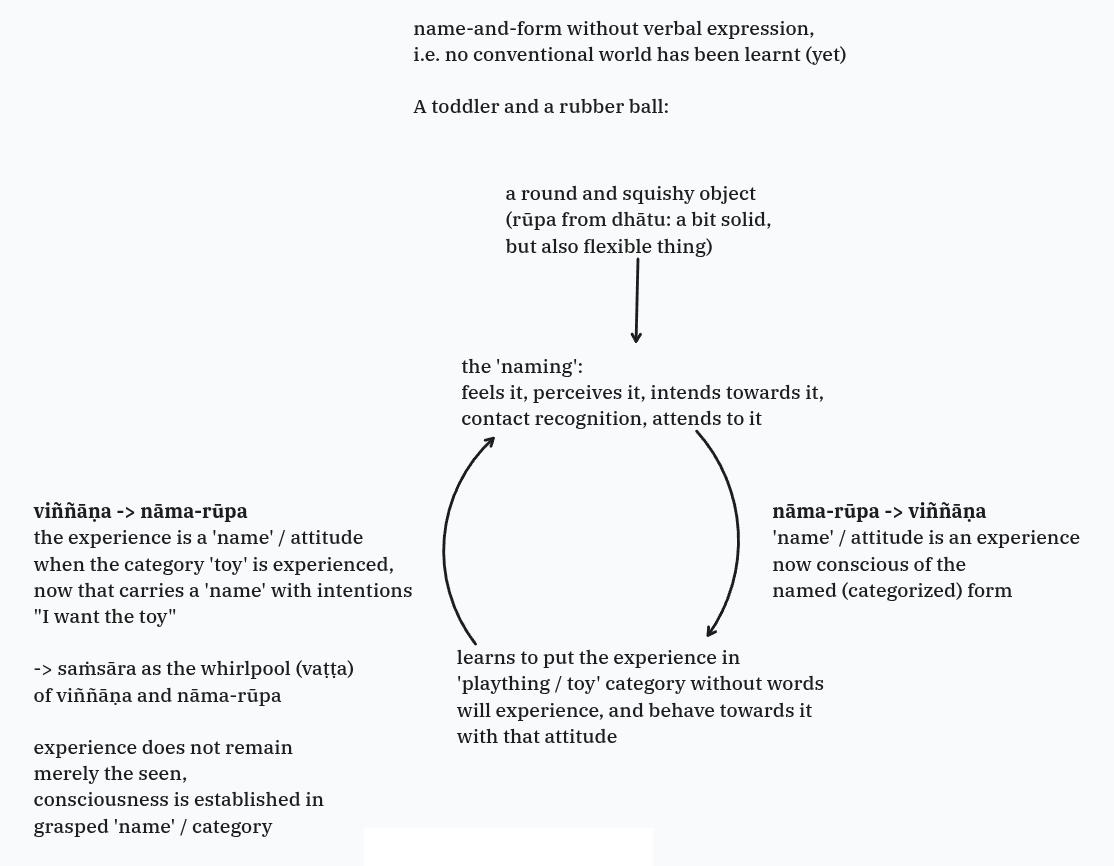
Snp 4.13 Mahābyūhasutta
Passaṁ naro dakkhati nāmarūpaṁ, / Disvāna vā ñassati tānimeva;
Kāmaṁ bahuṁ passatu appakaṁ vā, / Na hi tena suddhiṁ kusalā vadanti.
| passaṁ | (prp) seeing [passa + nta + aṁ] prp, masc & nt nom sg of passanta |
| nara | (masc) man; person masc |
| dakkhati 1 | (pr) sees; finds [dakkha + ti] pr |
| disvāna | (abs) having seen [√dis + tvāna] abs of √dis |
| ñassati 1 | (fut) will know; could know [√ñā + ssa + ti] fut of jānāti |
| tāni 1 | (pron) they; those; those things [ta + āni] pron, nt nom pl of ta |
| kāmaṁ 1 | (ind) freely; according to one's wishes; [kāma + aṁ] |
| bahu | (adj) many; much; lots; a lot (of); great; large [√bah + u] adj |
| appaka 1 | (adj) small; few; little [appa + ka] adj, from appa |
| suddhi | (fem) purity; purification; holiness; [√sudh + ti] |
| kusalā | (masc) masters; 'masters'; experts; 'experts' [kusala + ā] |
(Sermon 9) The man who claims to see with those higher knowledges is seeing only name-and-form, passaṁ naro dakkhiti nāmarūpaṁ. Having seen, he takes whatever he sees as real knowledge, disvāna vā ñassati tānim eva.
Just as someone inside a closed room with tinted window panes sees only what is reflected on those dark panes, and not beyond, even so, those 'seers' got enmeshed in name-and-form when they proceeded to speculate on what they saw as their past lives. They took name-and-form itself to be real.
Mumonkan Case 4: (13th cent.)
Wakuan, looking at Bodhidharma's picture, complained, 'Why does the Barbarian from the West have no beard?'
Heart Sūtra (Prajñāpāramitā): (7th cent.)
Form itself is emptiness, and emptiness itself is form. [...]
There are no eyes, ears, nose, tongue, body, or thoughts.
There are no forms, sounds, scents, tastes, sensations, or phenomena.
There is no field of vision and there is no realm of thoughts.
There is no ignorance nor elimination of ignorance, even up to and including no old age and death, nor elimination of old age and death.
DN 1 Brahmajālasutta
Tatra, bhikkhave, ye te samaṇabrāhmaṇā sassatavādā
sassataṁ attānañca lokañca paññapenti catūhi vatthūhi, tadapi phassapaccayā.
| ye 1 | (pron) whoever; whatever; whichever; those who |
| sassata | (adj) eternal; everlasting; endless; perpetual; [sassati + a] adj |
| paññapeti 1 | (pr) teaches; preaches; proclaims [pa + ñape + ti] pr, caus of pajānāti |
| catūhi 1 | (card) with four; by four [catu + ūhi] |
| vatthu 6 | (nt) basis; grounds (for) [√vas + tu] nt, from vasati |
| tadapi | (sandhi) that itself; just that [tad + api] |
SN 12.26 Upavāṇasutta
Paṭiccasamuppannaṁ kho, upavāṇa, dukkhaṁ vuttaṁ mayā. Kiṁ paṭicca? Phassaṁ paṭicca.
... Tatra, upavāṇa, ye te samaṇabrāhmaṇā sayaṅkataṁ dukkhaṁ paññapenti, tadapi phassapaccayā.
| mayā 1 | (pron) by me; with me pron, 1st instr sg of ahaṁ |
| paṭicca 1 | (ger) dependent; depending (on); because (of); grounded (on) [pati + √i + tya] |
| sayaṅkata | (adj) self-made; self-created [sayaṁ + kata] adj, comp |
SN 35.232 Koṭṭhikasutta
Āyasmā Mahākoṭṭhiko Āyasmantaṁ Sāriputtaṁ etadavoca:
"Kiṁ nu kho, āvuso sāriputta, cakkhu rūpānaṁ saṁyojanaṁ, rūpā cakkhussa saṁyojanaṁ ...
mano dhammānaṁ saṁyojanaṁ, dhammā manassa saṁyojanan"ti?
"Na kho, āvuso koṭṭhika, cakkhu rūpānaṁ saṁyojanaṁ, na rūpā cakkhussa saṁyojanaṁ.
Yañca tattha tadubhayaṁ paṭicca uppajjati chandarāgo taṁ tattha saṁyojanaṁ.
(simile of the two tied oxen)
Suppose there was a black ox and a white ox yoked by a single harness or yoke ...
Saṁvijjati kho, āvuso, bhagavato cakkhu. Passati bhagavā cakkhunā rūpaṁ.
Chandarāgo bhagavato natthi. Suvimuttacitto bhagavā.
... Saṁvijjati kho, āvuso, bhagavato mano. Vijānāti bhagavā manasā dhammaṁ.
Chandarāgo bhagavato natthi. Suvimuttacitto bhagavā.
| saṁyojana 1 | (nt) fetter; chain; bond; thing which binds [saṁ + yoje + ana] |
| saṁvijjati 1.1 | (pr) exists; is present; is found (in) [saṁ + vijja + ti] pr |
| bhagavato 2 | (masc) of the Buddha [√bhaj > bhag + a + vant + to], [bhagavant + to] |
| chandarāga | (masc) interest and passion; desire and lust [chanda + rāga] masc, comp |
| suvimuttacitta | (adj) with well liberated mind; with completely free heart [su + vimutta + citta] |
| vijānāti 1 | (pr) comprehends; recognises; distinguishes; is aware (of) [vi + jānā + ti] pr |
| manasā | (masc) by mind; with mind; mentally [manas + ā] masc, instr sg of manas |
Cognition of the Worldling and the Arahant
Contact (phassa) and the Upādāna-kkhandhā
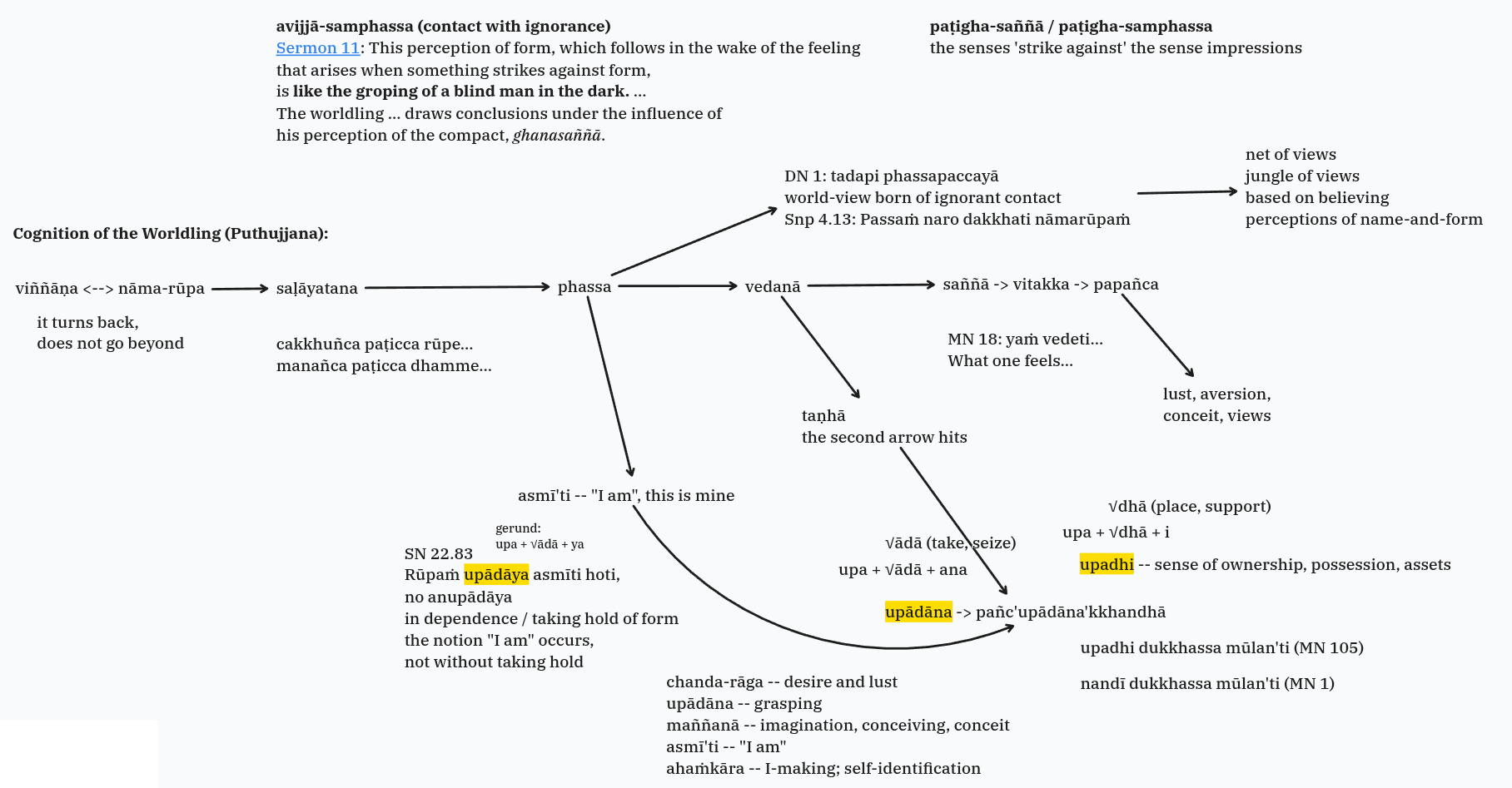
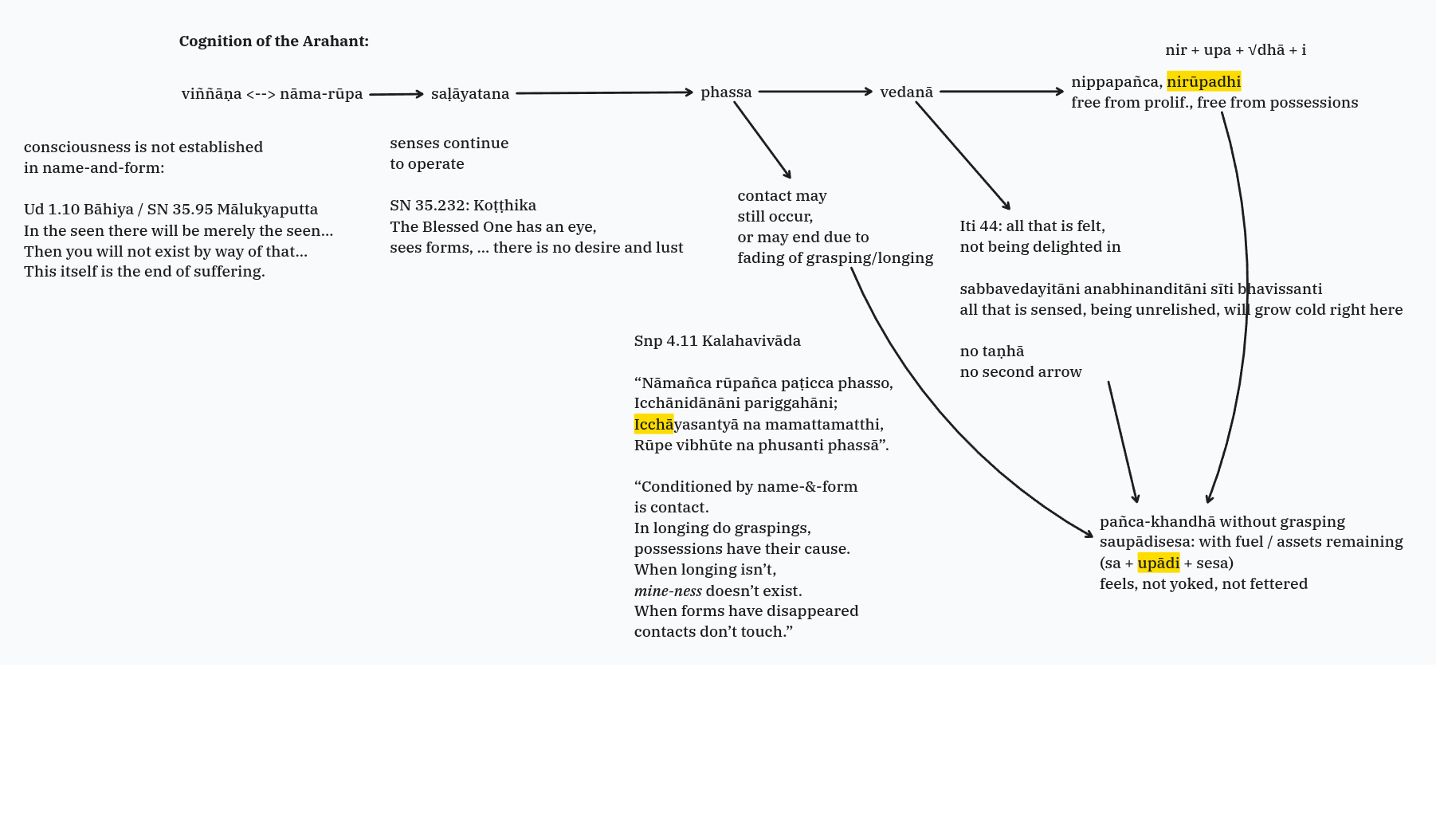
Experiental Blindness
Not to be confused with inattentional / perceptual blindness (gorilla walking through a scene), or illusions (optical or ambiguous), or Rorschach / inkblot test (free association), which are describing different parts of the process of cognition.
How Emotions Are Made: The Theory of Constructed Emotion - Forte Labs
"experiential blindness" -- the inability to perceive what you don't already have a concept for. Remember that we are not experiencing the world directly; we are experiencing our mental simulation of it. And without a concept for something, we can't incorporate it into our simulation.
1:05:11 Emotions are human-constructed concepts