2026-09-23
Forming verbs and nouns from roots
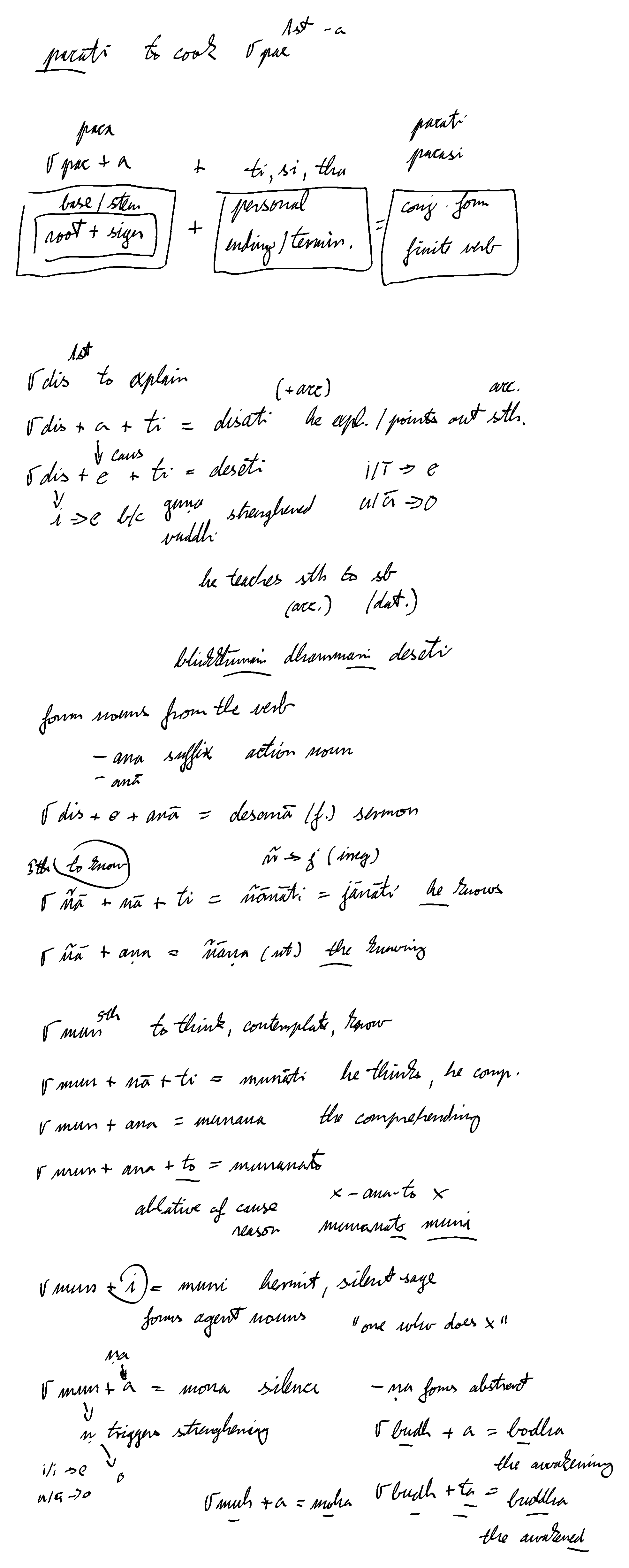
Papañca
(MN 16) Cakkhuñcāvuso, paṭicca rūpe ca uppajjati cakkhuviññāṇaṁ, tiṇṇaṁ saṅgati phasso ...
Manañcāvuso, paṭicca dhamme ca uppajjati manoviññāṇaṁ, tiṇṇaṁ saṅgati phasso,
phassapaccayā vedanā, yaṁ vedeti taṁ sañjānāti, yaṁ sañjānāti taṁ vitakketi,
yaṁ vitakketi taṁ papañceti, yaṁ papañceti
tatonidānaṁ purisaṁ papañcasaññāsaṅkhā samudācaranti
atītānāgatapaccuppannesu manoviññeyyesu dhammesu.
| paṭicca 1 | (ger) dependent; depending (on); because (of); [pati + √i + tya] ger of pacceti |
| uppajjati 1 | (pr) appears; arises; occurs; takes place (for or in) [ud + pajja + ti] pr |
| tiṇṇaṁ | (card) of three [ti + ānaṁ] card, masc & nt gen pl of ti |
| saṅgati 1 | (fem) union; coming together; meeting (of) [saṁ + √gam + ti] |
| vedeti 1 | (pr) feels; experiences; senses [vede + ti] pr |
| sañjānāti | (pr) knows; knows as; perceives; conceives; recognizes [saṁ + jānā + ti] pr |
| vitakketi | (pr) thinks (about); reflects (on); ponders (over) [vi + takke + ti] pr |
| papañceti | (pr) proliferates; forms various opinions (about) [pa + pañce + ti] pr |
| tatonidānaṁ | (ind) because of that; for that reason [tato + nidāna + aṁ] |
| purisa 1 | (masc) man; male; person masc |
| papañcasaññāsaṅkhā | (fem) proliferation of opinions, concepts and constructs; |
| papañca | (masc) various opinions; proliferation; endless conceptualization; |
| lit. expanding; spreading | |
| samudācarati 2.1 | (pr) overwhelms; assails; assaults; (comm) occurs [saṁ + ud + ā + cara + ti] pr |
| atītānāgatapaccuppanna | (adj) in the past, the future and the present [atīta + anāgata + paccuppanna] |
| manoviññeyya | (adj) knowable; known by the mind [mano + viññeyya] adj, comp |
Aj Thanissaro' introduction to MN 18:
... Sn 4:14 states that the root of the categories of papañca is the perception, "I am the thinker." From this self-reflexive thought ... a number of categories can be derived: being/not-being, me/not-me, mine/not-mine, doer/done-to, ... it's impossible not to be assailed by the perceptions & categories derived from these basic distinctions.
(Snp 4.14) Kathaṁ disvā nibbāti bhikkhu, / Anupādiyāno lokasmiṁ kiñci?
| kathaṁ 1 | (ind) how? [ka + thaṁ] ind, adv, interr, from ka |
| disvā | (abs) having seen; having understood; having found out [√dis + tvā] |
| nibbāti 1 | (pr) is completely quenched; is completely cooled [nī + bā + ti] pr |
| anupādiyāna | (prp) not attaching (to); not taking as mine; [na > an + upa + ādiya + āna] |
| loka 1 | (masc) world; universe; cosmos [√lok + a] masc |
| kiñci 3 | (pron) some; something; anything (object) [ka > ki + iṁ + ci] |
Mūlaṁ papañcasaṅkhāya, / Mantā asmīti sabbamuparundhe;
Yā kāci taṇhā ajjhattaṁ, / Tāsaṁ vinayā sadā sato sikkhe.
| mūla 2 | (nt) source; origin; root [√mūl + a] nt |
| papañcasaṅkhā | (fem) concepts due to proliferation [papañca + saṅkhā] fem, comp |
| mantā 1 | (fem) (comm) wisdom; understanding; intelligence [√mant + ā] fem, abstr, from manteti |
| asmi | (pr) I am [√as + mi] pr 1st sg of atthi |
| sabbaṁ | (ind) completely; altogether [sabba + aṁ] ind, adv, acc sg of sabba |
| uparundhati | (pr) stops; checks; blocks [upa + rundha + ti] pr |
| yā | (pron) whatever; whichever (woman) [ya + ā] pron, fem nom sg & pl of ya |
| kāci | (pron) some; any [ka + ci] pron, fem nom sg & pl of kaci |
| taṇhā 1 | (fem) craving; wanting; desire (for) [taṇhā + ā] fem, abstr, from tasati |
| ajjhattaṁ | (ind) internally; inwardly; personally ind, adv, comp, acc sg of ajjhatta |
| tāsaṁ 2 | (pron) of those; of them; their [ta + āsānaṁ > ās(ān)aṁ > āsaṁ] pron, fem gen pl of ta |
| vinaya 3 | (masc) removal; dispelling (of) [vi + √nī > nay + *a] masc, from vineti |
| sadā | (ind) always; ever; all the time [saṁ + dā] ind, adv, from saṁ |
| sata 1.1 | (pp) mindful; present; attentive [√sar + ta] pp of sarati |
| sikkhe | (opt) could train (for); should practice [√sikkh + e] opt of sikkhati |
Dhp 268-269 The silent sage
Na monena munī hoti, / mūḷharūpo aviddasu;
Yo ca tulaṁva paggayha, / varamādāya paṇḍito.Pāpāni parivajjeti, / sa munī tena so muni;
Yo munāti ubho loke, "muni" tena pavuccati.
| mona | (nt) silence [√mun > mon + *a] nt, from munāti |
| muni, munī (irreg) | (masc) monk; sage; seer; hermit; silent sage [√mun + i] masc, from munāti |
| munāti | (pr) knows; understands [munā + ti] pr |