2026-10-28
What is Pāli?
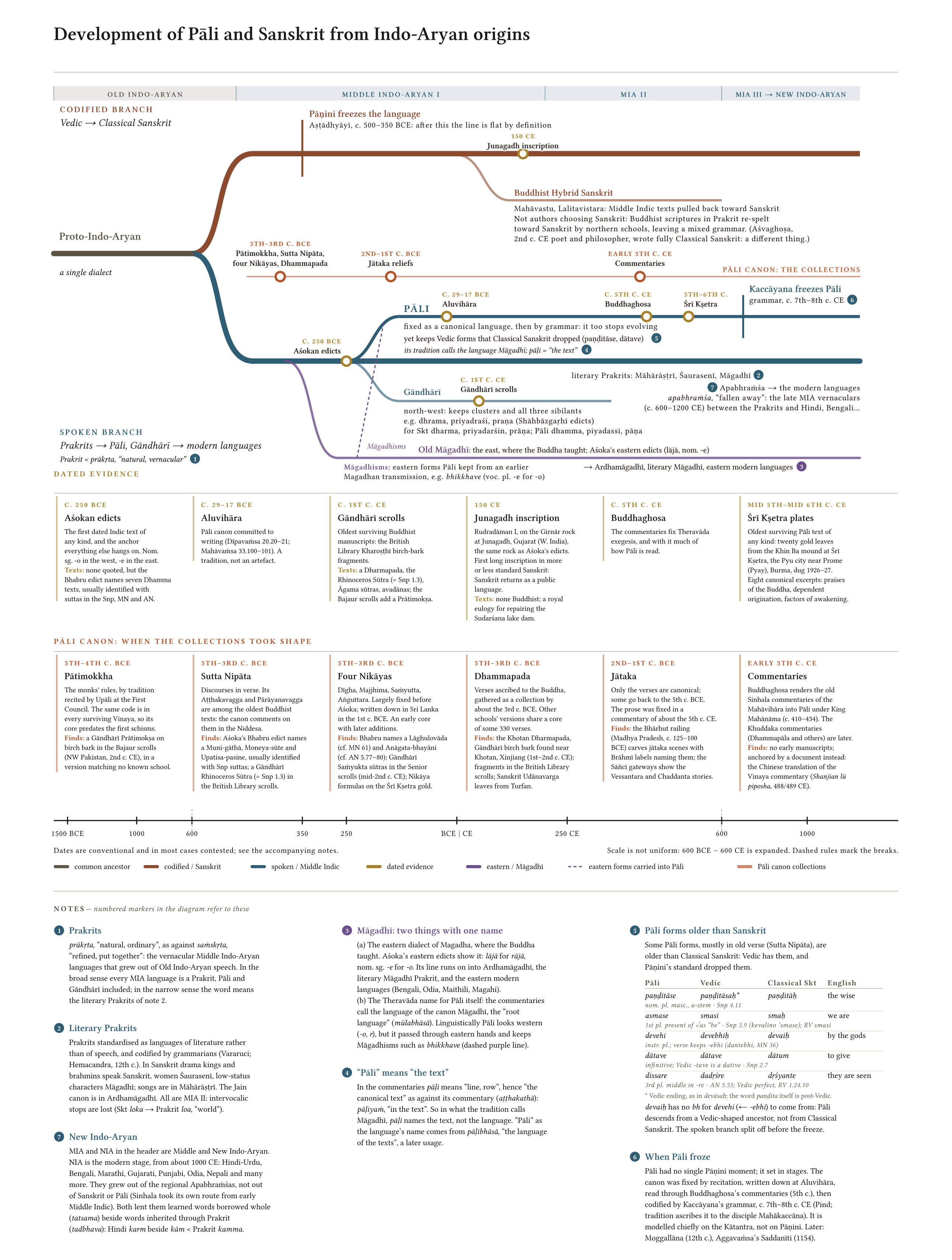
Development of Pāli and Sanskrit
(PDF link)
Related
- Magadha (wikipedia.org)
- Mahājanapadas c. 500 BCE, (wikipedia.org)
- Aśoka and the Use of Writing in Ancient India (researchgate.net, buddhistuniversity.net)

Common teatime quips
"The language in which the texts of the Theravāda school are preserved."
Yes, however that says where Pāli is found, not what it is: a standardised literary Middle Indic language, one Prakrit among several, which the Theravāda happened to preserve.
"Pāli in the Tipitaka means 'text', not a language."
Yes, in the texts themselves, pāḷi means "the canonical text" as against the commentary; the language is called Māgadhī there, and "Pāli" as its name comes from the later pāḷibhāsā, "language of the texts".
"Pāli is a newer and simplified Sanskrit."
No: both descend from Old Indo-Aryan; Pāli is a Middle Indic sibling that kept changing while Sanskrit was frozen by Pāṇini, and in places (buddhehi ← Vedic -ebhiḥ) it is older than Classical Sanskrit.
"Pāli was the language of the common people while Sanskrit was the holy language only for brahmins."
Only half right: Sanskrit was the brahmins' learned and ritual register, but Pāli was nobody's everyday speech either: it is a literary standard built on Middle Indic vernaculars, not a record of what people spoke at the market.
What did they speak at the market? Regional vernaculars, which survive only indirectly. The best direct evidence is later and far to the north-west: the Gāndhārī royal orders, complaints, accounts and sale agreements from Niya in the Tarim Basin (c. 235--325 CE), full of camels, debts and disputes. Today's equivalent is Magahi, the unfrozen descendant of the Magadhan vernacular, still spoken in Bihar.
"Pāli is a Buddhist Hybrid Sanskrit."
No: BHS is the language of northern-school texts re-spelt from a Prakrit toward Sanskrit (Mahāvastu, Lalitavistara); Pāli was Sanskritised only lightly and on the surface, with a few clusters restored as in brāhmaṇa (see the next answer), and remains a Middle Indic language in its own right.
"Pāli was created from Sanskrit for the purpose of recording and memorizing the suttas."
Not entirely wrong: Pāli did take shape in the transmission of the texts, but it grew out of Middle Indic, not out of Sanskrit, and nobody designed it. As the teachings spread, monks recast them from dialect to dialect, and over generations communal recitations evened the result out into an "ecclesiastical" language that matched no single spoken dialect (Norman 1983), i.e. it is not an invented language. The eastern relics like bhikkhave are leftovers of that recasting.
Sanskrit came in later, from about the end of Aśoka's reign until the canon was written down, and only as a surface layer. Redactors put back some consonant clusters piecemeal, not by any system, as in brāhmaṇa for Middle Indic bamhaṇa, and some of these clusters are false: disvā cannot come from dṛṣṭvā, nor atraja from ātmaja. That shows they were restored rather than inherited. The grammar underneath is still Middle Indic (-assa, -ehi, assimilated clusters), and in places it is older than Classical Sanskrit.
"Pāli was spoken by the Buddha and the suttas record what he said."
Not quite: the Buddha most likely taught in an eastern Middle Indic dialect related to Pāli, in Kosala as well as Magadha (Māgadhisms like bhikkhave are its traces), and the suttas are teaching compositions shaped for oral recitation, not verbatim transcripts.
Then what comes closest? Material that was meant to be memorised from the start, and that every school agrees on.
The core of the Pātimokkha is found in every surviving Vinaya lineage; the tradition has the Buddha laying down each rule and instituting its fortnightly recitation.
The stock formulas (the four truths, the jhāna sequence, dependent origination) recur nearly word for word in the Pāli Nikāyas, the Chinese Āgamas and the Gāndhārī scrolls, and Allon and Wynne argue that this fixed, formulaic style belongs to the earliest layer of composition rather than to later editing.
That makes them the best candidates for formulations the Buddha himself created or approved, with two limits. They preserve his wording in substance, not his exact syllables, since the texts changed dialect at least once on the way into Pāli. And both grew in transmission: the count of minor training rules (sekhiya) differs widely between schools, and stock passages were copied into suttas that had not first contained them.
The old verse of the Aṭṭhakavagga and Pārāyanavagga is a third candidate of a different kind: early by its language rather than by its being shared.
"Pāli was not spoken by the Buddha, but used at the first Council to standardize the texts."
Not quite: the First Council, as the tradition tells it, fixed the content by communal recitation, not a choice of language; Pāli's form settled gradually over centuries of transmission and was codified only by Kaccāyana's grammar.
"Pāli was one of the many languages in Magadha."
No: Pāli was a literary language, not one of the local spoken ones, and its sound profile is western rather than Magadhan (see the next answer).
"Pāli is the Māgadhī regional dialect."
No, though the tradition says so: the commentaries call the language of the canon "Māgadhī", the speech of Magadha where the Buddha taught. But the real dialect of Magadha, as Aśoka's eastern edicts record it, says lājā and -e where Pāli says rājā and -o. Pāli is a different, western-looking language that keeps only a few eastern forms, such as bhikkhave, left over from an earlier eastern stage of the texts.
Why does the tradition say Māgadhī? For several reasons that reinforce each other, though none of them is linguistic:
- Magadha was the Buddha's home base: its kings, Bimbisāra and Ajātasattu, were his patrons; the Veḷuvana at Rājagaha was the first monastery given to the Saṅgha; and the First Council, as tradition tells it, met at Rājagaha. He also spent many rains at Sāvatthī in Kosala, which is why so many suttas open there (§7.1).
- The texts reached Sri Lanka from Magadha. According to the chronicles, the Third Council met at Pāṭaliputta, Aśoka's capital in Magadha, and Aśoka's son Mahinda then carried the canon to the island. Magadhan was also the imperial chancery language: at many sites far from Magadha, Aśoka's edicts carry its eastern forms.
- Buddhaghosa takes sakāya niruttiyā (Cūḷavagga V.33, see §9) to mean the Buddha's own dialect, and calls that dialect Māgadhī: sakā nirutti nāma sammāsambuddhena vuttappakāro māgadhiko vohāro, "'own expression' means the Māgadhan usage as the Buddha spoke it".
- The commentaries go further and make Māgadhī the natural language of all beings. The Sammohavinodanī says that the child of a Tamil mother and an Andhaka father who heard neither parent first would speak Māgadhī, as would someone born in a great forest with no one to talk to. It says Māgadhī prevails in the hells, the animal and ghost realms, and the human and deva worlds; the other eighteen languages change, but Māgadhī, "the speech of Brahmās and noble ones" (brahmavohāra, ariyavohāra), does not. Later tradition sums this up by calling Māgadhī the mūlabhāsā, the "root language".
So the name records where the Buddha lived and taught, and where the texts came from. It is a claim about origin and authority, not a description of the language's sound system.
"Pāli is the word for 'text' in the Māgadhī language."
Yes, in the tradition's terms: the tradition's "Māgadhī" is simply the language we now call Pāli, and in it pāḷi means "the canonical text". Put in modern terms, pāḷi is the Pāli word for "text"; it says nothing about the spoken dialect of Magadha.
Lingua Franca and the Language at the First Council
What language could have served as a lingua franca while the Buddha was travelling among regions?
What language could have been used at the First Council?
TL;DR:
We should bear in mind:
- the distinction between literary and vernacular languages
- Pāli has always been literary, a language for teachings, verses, etc., not a conversational language. Only the literary forms survive. The vernacular, conversational form could have been as close as European Portugese to Brazilian, or could have been more distant, like Latin and Italian. (An example of literary language today could be the legal language of laws, which is not a conversational form, or the Hebrew of the Bible, which is distinct from "everyday" Hebrew).
- the eastern (Magadha) dialect VS western (both literary)
- the Buddha taught in the eastern region, and the teachings were later carried on in western India in their own dialect
- the content of a text and its pronounced form (accent, dialect)
- Pāli itself was changing over time, and even if the content of a text is resistant to change (e.g. repeated formulas, Pāṭimokkha, etc), and is carried on word-for-word, the dialect/accent the speakers pronounce it with changes, as evidenced by the different syllables on Aśoka's edicts, Gandhāri scrolls, etc.
Aśoka's eastern language reached Buddhist sites far from Magadha at Delhi (Bahapur edict) so its language was common enough that administration instructions were meant to be understood there. But the Kandahar edict is in Greek and Aramaic, so the eastern language clearly had a limit (see map below).
At the First Council they would have likely used the eastern speech of Magadha. The nearest evidence is the eastern language on Aśoka's pillars, about 150 years later (lājā for king, not the western rājā). The suttas were later taken up by the western regions and recast (hence we get rājā), but still retained some eastern forms such as bhikkhave. Then still later there was some light Sanskritisation when that was "in vogue". This put some consonant clusters back, so we get brāhmaṇa instead of something like bamhaṇa, and disvā, atraja.
Hence Norman concludes that Pāli in the exact form we have it probably did not yet exist in Aśoka's time (or earlier at the First Council). Its ancestor did, with no consonant clusters and a more eastern pronunciation.
To my non-linguist ear it still sounds pretty similar, so the distance to the language at the First Council could be something like that between strong regional dialects of one language, like eastern and central German.
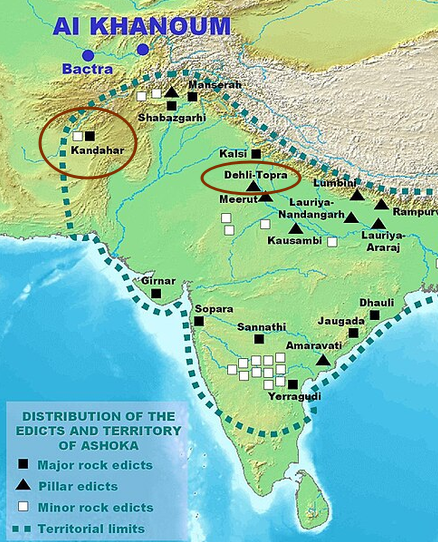
With a few more details:
Only the literary languages would have remaining dramas, songs, or carved artefacts, so claims about a spoken lingua franca cannot be proven, but there is the following:
Levman compares Pāli (literary language) sukhumaṁ sallaṁ durubbahaṁ (Theragāthā) with Ardha-Māgadhī (a literary Māgadhī) suhume salle duruddhare (Sūyagaḍa), both "a fine dart, hard to extract": the first two words differ regularly, but the third uses a different root.
There is speculation that the needs of trade and administration would make a lingua franca highly likely, but the evidence is from later than the Buddha's life.
Aśoka's eastern language reached Buddhist sites far from Magadha, and its instructions were meant to be understood there, at least by the officials and monks they addressed.
- Lumbini pillar, in the Buddha's birthplace:
lājina,hida Budhe jāte. - Bhabru edict, addressed to the Saṅgha, found in Rajasthan:
lājā Māgadhe. - Piprahwa relic casket, in Sakyan country, c. 3rd--2nd c. BCE:
salilanidhane,dalanaṁ, with easternlforr. This is a relic dedication, not an edict.
Some edicts were also heard, not only read. The Separate Edicts at Dhaulī and Jaugaḍa, in Kalinga, say that they "must be listened to" on set days.
How much further the eastern language was understood is less clear:
- Norman says the Māgadhī originals were "translated" into the local dialect or language across India, which suggests they were not enough as they stood. He adds that Girnār may be in part a scribe's attempt to convert the Eastern text into what he thought suited the region, not the actual local dialect.
- At Kandahar the edict is in Greek and Aramaic, so there the eastern language was not used at all.
- The people addressed were mostly officials and monks, so the edicts say little about what ordinary listeners understood.
If the First Council took place, they would have likely used the eastern speech of those present, around Magadha. No sample survives from that time. The nearest evidence is the eastern language on Aśoka's pillars, about 150 years later. On the usual account, the suttas were later taken up by the western regions and recast, so the words came out a bit differently:
The eastern edicts have king as lājā, where Pāli has the western-looking rājā, but Pāli still preserves some eastern relics such as bhikkhave as irregular forms.
Norman describes the canon's language in Aśoka's time as "perhaps the lingua franca of the Buddhists of Eastern India", and "not very different from the language of the Hathigumpha inscriptions". In it, he says, "all consonant clusters had either been assimilated or resolved".
(Assimilated means that one consonant takes over the other (sarva → sabba). Resolved means that an inserted vowel splits them (sneha → sineha).)
However this is not Pāli as we have it, because Pāli has clusters again. Norman puts this down to a period of light Sanskritisation. Some clusters were restored to their older forms, as in brāhmaṇa for something like bamhaṇa, and some were put in wrongly, as in disvā and atraja, which never had those clusters.
Hence Norman concludes that Pāli in the exact form we have it probably did not yet exist in Aśoka's time. Its ancestor did, with no consonant clusters and a more eastern pronunciation. Not everyone agrees: Karpik argues that the Buddha taught in Pāli itself.
Norman's timeline:
- Before about 250 BCE: oral transmission in Middle Indic dialects, which are losing their inherited clusters.
- Aśoka's time, c. 250 BCE: the canon's language has no clusters left, and is more eastern than Pāli. It would have said something like
bamhaṇa. This stage is reconstructed, not attested. - From about the end of Aśoka's reign (c. 235 BCE) to the writing down in the 1st c. BCE: Sanskrit regains prestige, and redactors restore some clusters (
brāhmaṇa), sometimes wrongly (disvā,atraja). - After the writing down: the Sanskritisation is "virtually fixed", and scribes make only minor changes. Norman reports Helmer Smith's view, that the canon as we have it reflects the Pāli of the twelfth century.
AN 5.36 Kāladānasutta (Kāle dadanti sapaññā)
(SC, Bhikkhu Manual)
"Pañcimāni, bhikkhave, kāladānāni. Katamāni pañca? Āgantukassa dānaṁ deti; gamikassa dānaṁ deti;
gilānassa dānaṁ deti; dubbhikkhe dānaṁ deti; yāni tāni navasassāni navaphalāni
tāni paṭhamaṁ sīlavantesu patiṭṭhāpeti. Imāni kho, bhikkhave, pañca kāladānānī'ti.
| āgantuka 1 | (masc) guest; newcomer; new arrival; stranger [āgantu + ka] from āgantar |
| deti 1 | (pr) gives (to); donates (to); offers (to); hands (to) [de + ti] |
| gamika 1 | (masc) traveller; leaver; who is going on a journey [√gam + ika] from gacchati |
| gilāna 1 | (adj) sick; ill; unwell [√gilā + ana] adj |
| dubbhikkha | (nt) famine; scarcity of alms-food [dur + √bhikkh + ā + a] nt, from bhikkhā |
| yāni | (pron) whichever (things) [ya + āni] pron, nt nom & acc pl of ya |
| tāni 1 | (pron) they; those; those things [ta + āni] pron, nt nom pl of ta |
| navasassa | (nt) first fruit of the harvest [nava + sassa] nt, comp |
| navaphala | (nt) first fruits of the season [nava + phala] nt, comp |
| paṭhamaṁ 1 | (ind) first; firstly; at first; first of all [paṭhama + aṁ] |
| sīlavant | (adj) virtuous; ethical; moral [sīla + vant] adj, from sīla |
| patiṭṭhāpeti 1 | (pr) sets (before); offers (to); gives (to); [pati + ṭhāpe + ti] caus of patiṭṭhāti |
Kāle dadanti sappaññā, / vadaññū vītamaccharā;
Kālena dinnaṁ ariyesu, / ujubhūtesu tādisu.
| kāle | (ind) at the right time; at the proper time [√kal > kāl + *a + e] |
| dadāti | (pr) gives; offers; donates; grants (something to) [dadā + ti] pr |
| sappañña | (adj) wise; intelligent [sa + pa + √ñā + a] adj, from pañña |
| vadaññū | (adj) generous; giving; liberal adj, comp |
| vītamacchara | (adj) selfless; not selfish [vīta + macchara] adj, comp |
| dinna 1 | (pp) given (to); offered (to) [√dā > dī + na] pp of dadāti |
| ujubhūta | (adj) straight; upright; erect [uju + bhūta] |
| tādi | (adj) such; of such character; of such quality; [taṁ > tā + disa + i] |
Vippasannamanā tassa, / vipulā hoti dakkhiṇā;
Ye tattha anumodanti, / veyyāvaccaṁ karonti vā;
Na tena dakkhiṇā ūnā, / tepi puññassa bhāgino.
| vippasannamana | (adj) with clear mind; with calm mind [vippasanna + mana] adj, comp |
| tassa 1 | (pron) to him; for him; to that; for that [ta + ssa] pron, masc & nt dat sg of ta |
| vipula 1 | (adj) vast; extensive; expansive; massive [vi + √pul + a] adj |
| dakkhiṇā 1 | (fem) gift; donation [√dakkh + iṇā] fem |
| ye 1 | (pron) whoever; whatever; whichever; those who [ya + e] pron, masc & nt nom pl of ya |
| tattha 1 | (ind) there; in that place [ta + ttha] ind, adv, from ta |
| anumodati 1 | (pr) approves (of); appreciates; applauds; is pleased (by) [anu + moda + ti] pr |
| veyyāvacca 1 | (nt) service; assistance [vyāvaṭa + *ya] nt, abstr, from vyāvaṭa |
| karonta 1 | (prp) doing; performing [karo + nta] prp of karoti |
| ūna 1 | (adj) deficient (in); lacking; wanting; short (by); less than (by) adj |
| bhāgī 1 | (masc) who shares (in); who partakes (in) masc, agent, from bhajati |
Tasmā dade appaṭivānacitto, / Yattha dinnaṁ mahapphalaṁ;
Puññāni paralokasmiṁ, / Patiṭṭhā honti pāṇinan"ti.
| tasmā 1 | (pron) from that [ta + smā] pron, masc & nt abl sg of ta |
| dada | (adj) giving; offering; bestowing [dadā + a] adj, from dadāti |
| appaṭivānacitta | (adj) not holding back; unhesitating; confident [appaṭivāna + citta] |
| yattha | (ind) wherever; where; when; in which [ya + ttha] ind, adv, from ya |
| dinna 1 | (pp) given (to); offered (to) [√dā > dī + na] pp of dadāti |
| puñña 1 | (nt) merit; good deed; spiritual wealth [√puṇ + ya] nt |
| paraloka | (masc) other world; next world; afterlife [para + loka] |
| patiṭṭhā | (fem) support (for); foundation (for) [pati + √ṭhā + ā] from patiṭṭhahati |
| pāṇī 1.1 | (masc) living being [pāṇa + ī] masc, agent, from pāṇa |
Kaṭhina Saṅghakamma
(SC: Mahāvagga, Kathinakkhandhaka, Kathinānujānana; Bhikkhu Manual)
Suṇātu me bhante saṅgho. Idaṁ saṅghassa kaṭhina-dussaṁ uppannaṁ. Yadi saṅghassa pattakallaṁ,
saṅgho imaṁ kaṭhina-dussaṁ āyasmato Amarassa dadeyya, kaṭhinaṁ attharituṁ. Esā ñatti.
| suṇātu | (imp) one must listen!; it must hear! [suṇā + tu] imp of suṇāti |
| kaṭhinadussa | (nt) cloth (to be made up) on the Kaṭhina nt |
| uppanna 1 | (pp) arisen; appeared; [ud + √pad + na] pp of uppajjati |
| yadi 1 | (ind) if; even; even if; perhaps [ya + di] ind |
| pattakalla | (nt) good time; suitable occasion (for) [patta + kalla] |
| imaṁ | (pron) this; this person; this thing [ima + aṁ] |
| āyasmant 1 | (masc) sir; venerable; reverend [āyas + mant] |
| amara 2 | (adj) undying; not subject to death; immortal [na > a + √mar + a] |
| dadeyya | (opt) would give (something to) [dadā + eyya] opt of dadāti |
| kaṭhina 1 | (nt) kathina privileges; kathina allowances nt |
| attharituṁ | (inf) to spread; to lay out [ā + √thar + ituṁ] inf of attharati |
| esā | (pron) she; this; this woman [eta + sā] pron, fem nom sg of eta |
| ñatti | (fem) (vinaya) motion; initial statement [√ñā + ti] from jānāpeti |
Suṇātu me bhante saṅgho. Idaṁ saṅghassa kaṭhina-dussaṁ uppannaṁ.
Saṅgho imaṁ kaṭhina-dussaṁ āyasmato Amarassa deti, kaṭhinaṁ attharituṁ.
Yass'āyasmato khamati, imassa kaṭhina-dussassa āyasmato Amarassa dānaṁ,
kaṭhinaṁ attharituṁ, so tuṇh'assa. Yassa nakkhamati, so bhāseyya.Dinnaṁ idaṁ saṅghena kaṭhina-dussaṁ āyasmato Amarassa, kaṭhinaṁ attharituṁ.
Khamati saṅghassa, tasmā tuṇhī. Evam-etaṁ dhārayāmi.
| deti 1 | (pr) gives; donates; offers; hands (to) [de + ti] pr |
| yassāyasmato | (sandhi) for that venerable who [yassa + āyasmato] |
| khamati 2 | (pr) seems good (to); is acceptable (to); is suitable (for) [khama + ti] |
| imassa 2 | (pron) of this; his [ima + ssa] pron, masc gen sg of ima |
| dāna 1.1 | (nt) giving; offering; charity; generosity [√dā + ana] from dadāti |
| tuṇhassa | (opt) one should remain silent [tuṇhi + assa] opt of tuṇhībhavati |
| yassa 1 | (pron) to whom; for whom; [ya + ssa] pron, masc & nt dat sg of ya |
| nakkhamati | (pr) is not acceptable (to); is not suitable (for) [na + khamati] |
| bhāseyya | (opt) should speak; should say [bhāsa + eyya] opt of bhāsati |
| dinna 1 | (pp) given; offered (to) [√dā > dī + na] pp of dadāti |
| tasmā 2 | (ind) therefore; that is why [ta + smā] ind, adv, abl sg of ta |
| tuṇhī 3 | (ind) silent; quiet ind, adv, from tuṇhī |
| evametaṁ | (sandhi) so it is; just like that; [evaṁ + etaṁ] |
| dhārayati 2 | (pr) takes; considers; believes; keeps in mind [dhāraya + ti] |